


Living in Space
"Why Humans Will Live in Space"
By: Bob Krone, PhD & Sherry Bell, PhD*
"Space activities hold important promise for humans on earth as a source
of needed energy, as a key element in the global economy, in the search
for scientific solutions to earth's environmental challenges, and even
in protecting our beautiful ecosystem from space- borne threats."
Edgar Mitchell, Sc. D., Apollo 14 Astronaut in his Foreword to
Sherry Bell, Ph.D. Editor, 2009, Living In Space: Cultural and
Social Dynamics, Opportunities, and Challenges in Permanent Space
Habitats.
Today's absence of human settlements in Space gives humankind the open
door to creatively design new communities flowing to space from
Earth. Earth's history records the dismal legacy of the inhuman
use of human beings and unending intolerance, conflict, suffering
and wars. We have an unprecedented opportunity to achieve
paradigm shift positive changes in human interactions. Achieving it
in Space will produce overwhelming evidence that the lessons learned
can be fed back to life on Earth.
There has been dramatic proof on Earth that human colonies
can evolve harmoniously and successfully. The International Space
Station (ISS) is one. There is also evidence that conflicting
nations can resolve their differences without war. Russia and
the United States ended in 1991 the forty-six year Cold War
between the Soviet Union and Allied nations forces without World
War III occurring.
International cooperation, advanced science and technologies and
collaborative wisdom can achieve human detente for the 1923 ethical
civilization vision of Albert Schweitzer. Human settlements in
Space in 2023 will mark the 100th year of Schweitzer's Philosophy
of Civilization. That plus the Law of Space Abundance, which
describes the benefits to Earth from resources in Space already
achieved, and predicts benefits beyond our current capability to
imagine, provide the reasons why humans will live in Space. It
is not only humankind's most worthy cause, it will be the
vehicle for humanity's long term survival.
Jonas Salk, in his The Survival of the Wisest, 1973, wrote:
"The choices which humans make from the alternatives available to
them will profoundly influence their own destiny." The Apollo 11
Lunar Module Placque reads: �We came in peace for all Mankind.�
That is the logical mission for the future of humans in Space.
Preliminary Agenda and Scheduled Speakers
| Friday: Room: Athenia (2nd Floor) |
| Time: 10 am - 10:05 am |
| Welcome to Living in Space Track |
| Dr. Bob Krone and Dr. Sherry Bell |
| Kepler Space Institute |
| Time: 10:05 am - 10:10 am |
| Presentation Title: Space Philosophy |
| Dr. Bob Krone |
| Provost, Kepler Space Institute |
| Time: 10:10 am - 10:50 am |
| Presentation Title: Employees in Space - Protecting their Health |
| Dr. Bill Tarver, M.D. (Bio) |
| Medical Director, Clinical Services Branch, NASA Johnson Space Center |
| Time: 10:50 am - 11 am |
| Break |
| Time: 11 am - 11:10 am |
| Presentation Title: To Be Announced |
| NASA/NSS Student Space Settlement Contest Presentation |
| Time: 11:10 am - 11:20 am |
| Presentation Title: To Be Announced |
| NASA/NSS Student Space Settlement Contest Presentation |
| Time: 11:20 am - 11:50 am |
| Presentation Title: Lunar Resources for Immediate Revenue Generation |
| Charles Radley (Bio) |
| VP Projects and Programs, Leeward Space Foundation. |
| Time: 11:50 am - 12 pm |
| Break |
| Time: 12 pm - 2 pm |
| Lunch |
| Time: 2 pm - 2:15 pm |
| Presentation Title: Moon Arts Group � Project |
| Dean Professor Lowry Burgess (Bio) |
| Professor of Art, School of Art, former Dean of the College of Fine Arts, Carnegie Mellon University |
| Time: 2:15 pm - 2:30 pm |
| Presentation Title: An Artists Home in Space: An Introduction to Kalpana One |
| Bryan Versteeg (Bio) |
| Science Conceptual Artist |
| Time: 2:30 pm - 2:50 pm |
| Presentation Title: The Antecedent Estate of Aether Revisited |
| Declan J. O'Donnell, Sr., Esq. (Bio) |
| Lawyer, President, Declan Joseph O'Donnell, P.C. |
| Time: 3 pm |
| Living in Space Track Break for the Day |
| Saturday: Room: Athenia (2nd Floor) |
| Time: 10 am - 10:10 am |
| Presentation Title: To Be Announced |
| NASA/NSS Student Space Settlement Contest Presentation |
| Time: 10:10 am - 10:25 am |
| Presentation Title: Astrosettlements |
| Dr. Thomas Matula (Bio) |
| President, Astrosettlements |
| Kevin Greene (Bio) |
| Vice President, Astrosettlements |
| Time: 10:25 am - 10:35 am |
| Presentation Title: Ten Life Lessons from Project Apollo |
| George Schellenger (Bio) |
| Director & Executive Producer, Status Productions. |
| Time: 10:35 am - 10:50 am |
| Presentation Title: How The Cratersville Vision inspired An Upcoming Architectural Contest |
| Dr. John Wilkes, Ph.D. (Bio) |
| Professor of Sociology, Worcester Polytechnic Institute |
| Time: 10:50 am - 11 am |
| Break |
| Time: 11 am - 11:50 am |
| Presentation Title: Near-Term Wheel Station Concept |
| John Cserep (Bio) |
| Engineer |
| Time: 11:50 am - 12 pm |
| Closing Comments Including Space Philosophy |
| Dr. Bob Krone and Dr. Sherry Bell |
| Kepler Space Institute |
Speaker's Bio

Professor of Art, School of Art, former Dean of the College of Fine Arts, Carnegie Mellon University
Having been educated at the Pennsylvania Academy of the Fine Arts and the University of Pennsylvania and at the Instituto Allende in San Miguel Mexico, Lowry Burgess is an internationally renowned artist and educator who created the first official art payload taken into outer space by NASA in 1989 among his many Space Art works. He is considered one of the few pioneers of the Space Art movement that now has grown to hundreds of artists all over the world.
After the destruction of the Buddhas in Bamiyan, Afghanistan in 2001, he authored the "Toronto Manifesto, The Right to Human Memory" that received worldwide endorsement. One of the provisions of the Manifesto has led to the creation of a new global value/incentive for the protection of cultural sites throughout the world. This new value/incentive is in the process being implemented by UNESCO and the World Bank.
His artworks are in museums and archives in the US and Europe. He has exhibited widely in art and science museums in the US, Canada, throughout Europe, as well as Japan including various internationals such as Documenta, the Vienna Biennal and his recent solo exhibition at the Carnegie Museum of Art. Art Historian Raymond Vezina, at the University of Quebec, states that "He shares this utopic, visionary tradition extending from Saint Augustine, through Dante, Thomas Moore to William Blake and the American transcendentalists of the 19th century: Henry David Thoreau, Ralph Waldo Emerson and, more recently Gyorgy Kepes."
He is Professor of Art and former Dean of the College of Fine Arts and Distinguished Fellow in the STUDIO for Creative Inquiry at Carnegie Mellon University. He has founded and administrated many departments, programs and institutions during his 45 years as an educator in the arts. He has created curricula in the arts and humanities in the US and Europe while serving for twelve years on the National Humanities Faculty.
For 27 years he has been a Fellow, Senior Consultant and Advisor at the Center for Advanced Visual Studies at MIT in Cambridge, Massachusetts where he created and directed large collaborative projects and festivals in the US and Europe.
"First Night", the international New Year's arts festival, was created and founded by him. He originated the first "Arts in the Subways" program for the Department of Transportation and has developed and advised in more than a dozen major city scale projects.
He has received awards from the American Academy of Arts and Letters, the National Institute of Arts and Letters, the Guggenheim Foundation, the Rockefeller Foundation and several awards from the National Endowment for the Arts and the Massachusetts Artists Foundation, and the Kellogg Foundation and the Berkmann Fund. He received the Leonardo Da Vinci Space Art Award from the National Space Society. His book, "Burgess, the Quiet Axis" received the Imperishable Gold Award from Le Devoir in Montreal.
Among his hundreds of exhibitions and performances, most recently, his artworks have been exhibited at SETI in Mountain View, CA., the Festival of Art Outsiders, and the CNES, the French Space Agency in Paris, as well as a solo exhibition at the Carnegie Museum of Art in Pittsburgh and with his newly formed "Deep Space Signaling Group" in an artwork involving the International Space Station and NASA in April 2008. He continues work on new aspects of his lifework, the "Quiet Axis".
He has been featured in television and radio broadcasts in the US, Europe, Canada and Japan. (NOVA, "Artists in the Lab"; Smithsonian World, "Elephant on a Hill", "Artists of Earthwatch": "Arts and New Technologies" (Tokyo 12); "Artransition" (Austrian, German National Television and 24 other state television systems); "The Quiet Axis" (Hungarian State Television), and more than two hundred national and international radio broadcasts including 3 NPR broadcasts on his works. He has appeared on CBS Today Show and in numerous other appearances on television in Canada and Europe and has been widely published in numerous newspapers and magazines.

Engineer
Former L-5 Society member, former Director of Space Frontier Foundation, has presented on space colonization at four previous ISDC's.

Dr. Krone is a former U.S. Air Force jet pilot, commander, headquarters personnel officer, and chief of the nuclear policy section of NATO. He is an emeritus professor of systems management at the University of Southern California, a distinguished visiting professor in the school of business at La Sierra University, and an adjunct professor for doctoral programs for the International Graduate School of Business at the University of South Australia. He is also a member of the Aerospace Technology Working Group.

President, Astrosettlement
Dr. Matula is President of Astrosettlements. He has a Ph.D. in Business Administration and had published a number of articles on space commerce, spaceport and the economic development of space.

Declan J. O'Donnell is an attorney practicing general trial law in Colorado; President of the World of Space Bar Association; President of United Societies in Space, Inc., and of its Regency of United Societies in Space, Inc. (ROUSIS); Board of Directors, Mars Society; Board of Directors, Lunar Economic Development Authority Corporation, Inc.; Board of Directors,Space Orbital Development Authority Corporation; Publisher, Space Governance Journal; and member , AIAA Subcommittee on Space Colonization and the International Institute of Space Law, American Astronautical Society, and the National Space Society.

VP Projects and Programs, Leeward Space Foundation.
Charles Radley is a spacecraft systems engineer who has worked on manned and unmanned spacecraft development and operations. Professional background includes B.S. Physics, M.S. Systems Engineering, 20+ years aerospace experience. He is an EIT Engineer in Training registered in the State of California, and an Associate Fellow of the American Institute of Aeronautics and Astronautics.
In 1981 he started work on communications satellite systems integration, launch campaigns and range safety. Later he was instrumental in developing proposals for lunar space missions for the 1990 Space Exploration Initiative. He was a member of the subcontractor teams for the Galileo and Magellan space probes, the International Space Station, experiments for Spacelab-MSL-1 and several communications satellite projects (e.g. Intelsat-6, Olympus, HS-601, HS-376, Inmarsat-2, Marecs). He worked on the Mobile Transporter, and the power system for NASA Space Station Freedom which became ISS. He is an inter-disciplinary engineer, specializing in systems safety and hazards analysis as well as mission operations. He was principal author of the NASA Guidebook for Safety Critical Software. Was a part time technical consultant for Transorbital Corporation, the first private company licensed by the U.S. government to explore and land on the Moon. He had a key role developing the design and perigee stage for the Trailblazer imaging lunar orbiter for .
In 1968 he read about Solar Power Satellites and said ... Yes, this is THE solution. In 1976 he heard about Gerard O'Neill so in 1977 I read the High Frontier, and said, yes, finally a plan which makes sense. For the last 30 years continues to work on the original O'Neill vision with the addition of a lunar elevator. He joined the original L-5 Society in 1979. He was a regional director of the National Space Society (NSS) from 1994-5 and operated an NSS computer bulletin board on fidonet from 1990 through 1992. He has been active in the following NSS Chapters: Ventura County (CA), Cuyahoga Valley Space Society (OH), Oregon-L5; as well as active in the California Space Development Council and Midwest Space Development Corporation. He served a 2- year term as a director of the Moon Society, and later a 2-year term as its Vice President. In 2010 he became Vice President of Leeward Space Foundation, for PR and Programs.
He has written extensively on space based solar power, e.g. in the 2009 McGraw-Hill Encyclopedia of Science. He was a contributor to the 2007 Department of Defense study on Space Based Solar Power managed by the National Space Security Office. In 2008 he managed a project by the Moon Society to build a one watt desktop microwave power beaming device and obtained the first ever FCC license for operation of a power beaming device in a public place. He pursues concepts for space manufacturing using lunar resources. He is thoroughly grounded in real world practical spacecraft technology and cost issues, as well as appreciating the big picture long term roadmap for lunar development. In recent years he has been engaged mainly as a software quality engineer in commercial and government IT environments.

Director & Executive Producer, Status Productions.
George C. Schellenger covered the winning Ansari X PRIZE Flights in 2004 for AOL helping to create an online sensation before the days of YouTube. He also developed coverage of Discovery's Return to Flight in 2005 for AOL Time Warner. He went on to work on the original X PRIZE Cup in 2005 and he worked for the X PRIZE Foundation to help create the Northrup Gruman Lunar Lander Challenge at the X PRIZE Cup in 2006. He produced the first Air & Space show at the Kennedy Space Center in 2007. He is an expert shark driver who recently joined a team to take Sir Richard Branson to see Tiger Sharks in the Bahamas. This two-time Emmy Award winning producer has now written a soon to be published novel called - Not Because It's Easy... about a billionaire who wants to go back to the moon. He believes the lessons of Project Apollo are still relevant today.

Medical Director, Clinical Services Branch, NASA Johnson Space Center
Board certified aerospace medicine and occupational medicine physician currently directing clinical services at NASA where he is responsible for the healthy and medical certification of US astronauts. Dr. Tarver has been in the Flight Medicine Clinic at JSC since 2005. Prior to NASA, Dr. Tarver was in private practice doing occupational and preventive medicine as well as senior FAA AME (flight physicals). 20+ years of aerospace and occupational medicine experience in both federal and private practice arenas.

Professor of Sociology, Worcester Polytechnic Institute
John Wilkes is a Professor of Sociology at the Worcester Polytechnic Institute with a PhD from Cornell (1976) and a longstanding interest in unusually successful Aerospace R and D teams, the NASA mindset and space policy more generally. His interest in Science, Technology and Society issues meshed well with the WPI projects program calling for each student to examine the society-technology interface during their Junior year. The result has been a series of collaborations with technically sophisticated students in aerospace, robotics and other technical fields on potentially transformative technologies on the likely social implications of a variety of potential technical breakthroughs. In recent years his projects have focused on the implications of a new age of discovery in space and the necessary enabling technologies. In 2010 he led a team that entered a lunar base contest that tied for first in technical feasibility and elegance, in part by borrowing some ideas developed by the Mars Foundation. The resulting lively debate about priorities in space policy involving the moon and Mars has resulted in an interesting vision of how to do both and how to think about the relationship between these initiatives and the larger space infrastructure required to do them by 2069 and how to have an emerging system of interdependent space based facilities pay for itself.

Deep Space Industries, Spacehabs.com, Mars One
Bryan Versteeg is a conceptual artist producing visualizations depicting concepts in space exploration; Bryan has worked in the graphics industry for almost 25 years, the architectural industry for almost 20 years, and has been focusing on space for 5 years. His work can be found in companies and organizations like Deep Space Industries, Spacehabs.com, Mars One.
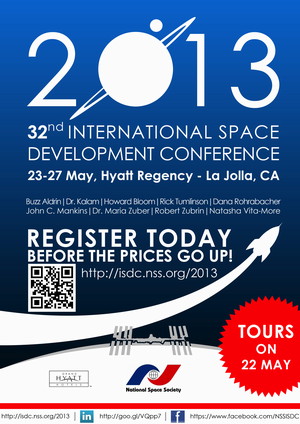
About ISDC 2013 SSP Track Chairs, Dr. Sherry Bell, Ph.D. and Dr. Bob Krone, Ph.D.

Sherry, Bell, PhD. Member National Space Society (NSS) Board of Directors and Dean of the School of Psychology, Kepler Space Institute; and Bob Krone, PhD , Provost of Kepler Space Institute (KSI) The NSS & KSI have a formal agreement facilitating collaborations





Special thanks to our Sponsors, Co-Sponsors, Exhibitors, Supporters and Affiliates.